DIARY OF TRIP TO ETHIOPIA
BY MARENA GRAY
Marena is 11 years old and currently lives in Abu Dhabi with her family, having moved there early 2008. She, her mother Phillipa and her 7 year old sister Jasmine came with Ross & Marianne Allan and Robyn Beetham on their site visits in Tigray this past October. These are her words:
Sunday 12 October 2008
Dear Diary,
Today was fascinating! Firstly Mum, Jasmine and I woke up at 5.30 in the morning and drove to Dubai International airport. There, we climbed onto an Emirates direct flight to Addis Ababa at 8.30.
The flight was three and a quarter hours long. After we picked out our bags from the carousel, we met up with Ross Allan, founder of the WellWishers Foundation. We drove to our hotel in Addis Ababa, where we stayed the night. The houses we passed on the way were made of mud or timber, in some cases with plastic for roofs. Many didn’t even have a roof.
Later on we went on a drive. We first went to the Hilton to change US Dollars into Birrs, the local currency. We drove past the President’s and the Prime Minister’s private homes. We went to a church and a museum. In the museum it showed pictures of the King and Queen, with their crowns, robes and precious gifts under glass. It was sad that these precious objects were not kept under better museum conditions as it was obvious that they were not being conserved properly.
Everyone climbed the bell-tower – it was very narrow – and reached the top. The bell was really heavy, I couldn’t ring it! In the church, our guide told us about all the paintings inside. He also showed us and told us about some traditional instruments. Jassy and I played a double-sided drum. It was fun.
At the Ghion Hotel gardens, there were 3 wedding parties who were having pictures taken at the same time. It is a very popular park for wedding photos. It was lovely to see the different groups respected each othe’rs wedding parties. The brides wore different dresses with the bridesmaids in many varied colours. Overall, it was the brilliant mix of colours that made this such a typically African wedding scene. We would never witness such bright colours at our weddings. Also the groups had choirs of people chanting, singing and dancing to celebrate the newly weds. It was a very colourful and festive occasion. We were made to feel very welcome at this event.
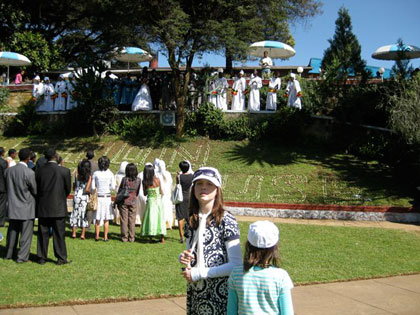
Wedding Groups at The Ghion.
After this we drove up to Entoto Mountain. The altitude was around 3000 metres above sea level. It is this mountain that the Ethiopian Olympic runners train up and down. They consistently win gold medals in their events, as a result of running in such altitudes. The view was amazing and there were loads of Eucalyptus trees around. I loved the smell of the eucalypts! Apparently these gum trees grow very quickly. That is the reason why a foreign minister visiting Australia in the 1890’s decided to bring some saplings back to grow them here. If people chop the trees down but keep the stump, the trees will sprout again quickly to replace the old one. Cool huh! Along the road up we saw sheep, and goats and donkeys hauling loads of firewood.
I also learnt that Addis Ababa means “New Flower”. Everywhere we looked up on the mountain were beautiful yellow wild flowers. These are called Meskal, which is Ethiopia’s National Flower. By the way, we didn’t see one, but their National Animal is the lion.
Tomorrow we will by flying north to Mekelle. Another early start – 5.30 am Whoa!
Love Marena
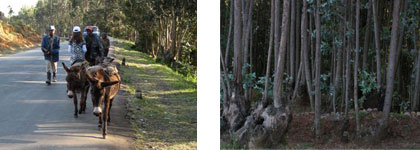
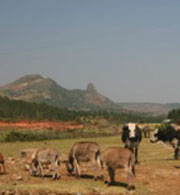
Donkeys and Eucalyptus.................See how they use the trees?
Monday 13 October 2008
Dear Diary,
Day 2 – check!
We rose early to go to Addis Ababa International Airport to fly to Mekelle – the capital of Tigray. Mekelle has a population of about 400,000 people. 10,000 of whom go to the local university – education is a big thing in Ethiopia. People really value it as it is a precious commodity.
When we arrived in Tigray, Ross, Robyn and Dawit [the NCA Programme Mgr] went into a meeting at REST [Relief Society of Tigray] to discuss WellWishers business, and to plan their schedule for the following days in the remote villages of Tigray. Marianne Allan, Mum, Jassy and I went to a huge memorial that could be seen from all over the town. It was giant, towering over us. On one side stood freedom fighters, while on the other side were statues of people who had to leave their homes to seek refuge elsewhere because of the war. Below it stood a museum that housed many photos, charts, guns and canons relating to the various wars that have been fought in Tigray over their boundaries with Eritrea as well as the occupation of troops from Italy. It gave us a very interesting brief history of Tigray.
We met up with the others and went to lunch at a traditional restaurant. We were offered traditional “Fasting Food” called Shiroh Wot [spicy chickpea sauce] and Injera [which is like a giant pancake with lots of bubbles, usually eaten with either meat or sauce]. We then started on our journey to Axum which took six and a half hours of bumpy, windy “roads”, round huge gorges and stunning valleys with magnificent mountain back-drops. We finally arrived at night in Axum, famous for being the original capital of Tigray and the ancient capital of Ethiopia and of the Queen of Sheba Empire. We visited the baths that she apparently bathed in.
Dinner is now being served here in Axum. No early starts tomorrow – about 7.15 am – AAHHH!!!
Love Marena
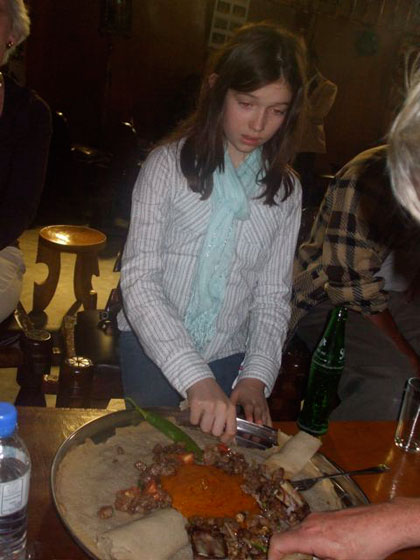
Shiroh Wot with Injera.
Tuesday 14 October 2008
Dear Diary,
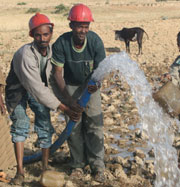
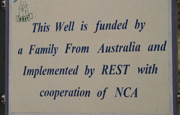
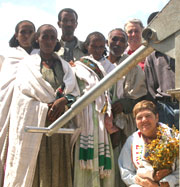
Today was the best day of my life!!!! We went to a village which was given a water well 8 months ago. People swarmed to welcome us, stopping school and work to be there to say thank you. There were over 1,000 people there. We sat upon a bench shaded by umbrellas held by some of the local people. We listened to all the speeches made by various people in the huge crowd wishing to express their joy and gratitude for being given a well. They told us in Tigringa [translated by one of the REST guides] how important the well was in their lives and what an amazing difference it had made to the quality of their everyday lives.
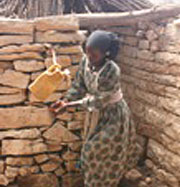
The sorts of things they told us was how, with a well close by with clean water, they were all much healthier and did not feel so tired and sick all the time. It also meant that the young girls who used to walk for kilometres over very rough terrain to collect water, now have time to attend school and be educated. It also meant that the mothers had more time to clean their houses, work in the fields, and to rest. Their lives were totally improved in so many ways because of this one well. The well catered for about 1,000 people in the village, but people in neighbouring villages, currently without a well, would be able to access this water also.
After the speeches, we danced and sang our way with the villagers to the training centre, where we were special guests for lunch. They slaughtered a goat for lunch to serve with the injera. That is a huge thing for them, and we were very moved by their generosity. We first were served bread, hard-boiled eggs from their chickens, and big spoonfuls of home-made organic honey. After this we were given lots of yummy beans, and then the injera with roasted goat.
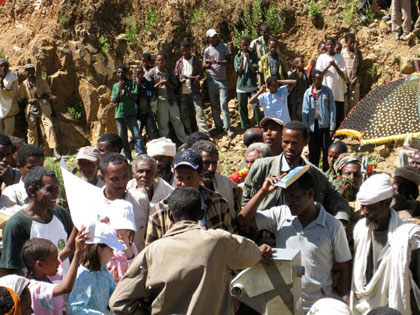
My first village visit - amazing!!
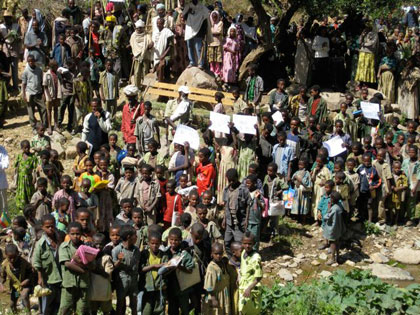
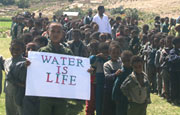
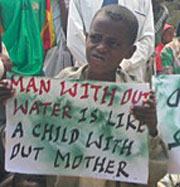
The crowd included children with their signs of welcome and messages about health.
A Tigringan woman took Jasmine’s and my hands, and led us up the hill to her home. The REST guide assured us that we should go with her, as she loved white people. She had 2 dogs, a cat and a few chickens in her yard, along with the kitchen and a latrine. Inside her home, there was dried meat hanging near the ceiling. At the back of her house were 6 big containers storing grain, wheat and teff [a fine kind of wheat used to make injera]. There was a single bed against the wall. Then on the other side was a bench covered with a blanket.
Apparently the lady couldn’t have babies. A few years ago she was very sick and had to go to Addis Ababa for an operation. She was treated by a couple of white doctors and they wanted to have her live with them permanently: but she missed her own village and went back. She has never forgotten their kindness and that she owes her life to them. Ever since she has loved white people and wanted to give something in return. She offered us her biggest and most beautiful chicken. We were very moved, but it seemed she needed this chicken more than us. Anyway, we told her it would be difficult for us to take it home on the plane. Instead, I gave her my pink scarf, and she gave me a stunning Injera lid of many beautiful colours. My scarf really suited her and she loved it! Mum had always wanted one of those decorative lids, so it was a good trade. She was such a lovely woman.
[Note: For those of you who may have heard or read of Catherine Hamlin and her husband Reg, Marena’s ‘lovely woman’, was treated at “The Hospital by the River”, the Addis Ababa Fistula Hospital.]
I said earlier today: “Today is the most magical day of my life”. I believe that this is true from the bottom of my heart. Ross, Marianne, Robyn and Mum all admitted to shedding tears during the moving speeches of gratitude from the local people.
There is nothing to compare with this in our world – it is a true indication of our shared humanity – of black and white helping each other to create a better world! Emotionally drained we all drove back lost in our own thoughts. What a day!
Love Marena
PS. The day only got better when we drove around a bend and saw where we would be staying for two nights – a beautiful lodge in traditional Tigrayan farm style, surrounded by mountains owned by a retired Italian engineer. There were animals scattered everywhere, free to go where ever they pleased. Jassy and I got to ride on “Caleb” their pony named after the first king of Ethiopia. It was so much fun – our giggling could be heard across the valley – according to the other evening guests.
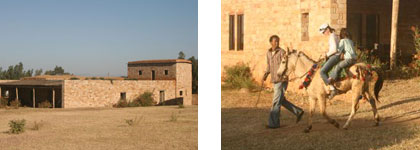
The classic lines of Tigrayan architecture and
Jasmine and I riding Caleb.
www.gheraltalodgetigrai.com
Wednesday 15 October 2008
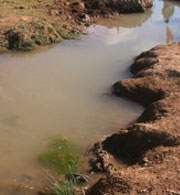
Another magical day! We went to another village, but this time, one that wanted a well. We saw where they took their water from for drinking etc. it was very dirty and always full of tadpoles. It was used by the livestock as well as people. This is very unhygienic and leads to water-bourne diseases, often resulting in death. Ross and the REST team would evaluate the village, to see if it met their criteria of servicing enough people and being far enough away from an existing well.
We then went to the local market in Hawzein. They sold absolutely everything you could imagine in a rural village. From spices to shoes, from honey to hats, from clothes to camels, goats, beads, cattle, donkeys, fruit and veges, farming tools, coffee, cooking bowls and cups, grasses for weaving, brooms, feather cleaners all arrayed amongst the milling crowds of kids and adults. There were people grinding wheat and teff, sewing garments and shining shoes. It was busy, busy, busy and so colourful and interesting!
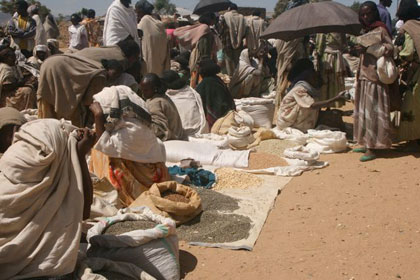
Lentils at the Hawzien markets
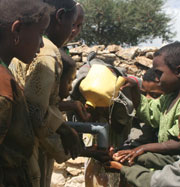
Afterwards, we went to a village school. There were 2,288 school children who turned out to welcome us and tell us why they needed a well near their school. They all brought their yellow water containers for 2 reasons. Firstly, it was “National Hand-washing Day”, which was an initiative to bring awareness to the people of the importance of washing hands before eating food. Also, they used their water containers to make the point that they were really desperate for a well to service their school and village. They waved their water bottles in time to singing their songs and National Anthem to us. It was very emotional, especially when the song was chorused with “kisses” to us. They are very aware of how much they need our help from overseas, and that it will change their lives significantly. Jasmine and I gave school supplies that we had brought with us like pencils, crayons, stickers, paper and teaching charts. They were very grateful and cheered us again and again!

The school kids with their yellow bottles first.
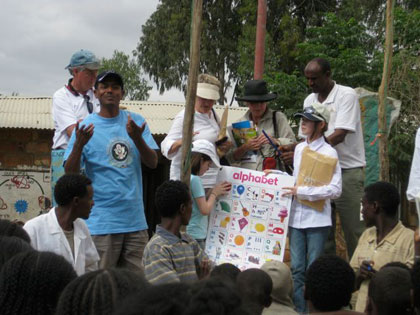
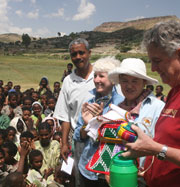
Presenting the charts.
We were invited into the school director’s office, where there were two old typewriters and a gestetner machine for copying. There was no electricity, so these were their only way of typing and printing. We then were given a tour around the school which had the equivalent of textbooks drawn and painted on the outside walls. This is very typical in the area. The children go outside to study things like the map of the world, parts of the body, food chains or the like.
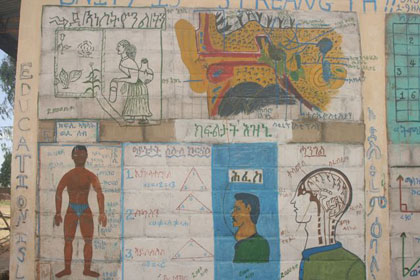
The 'Text Book' on the wall.
Inside the classrooms, children sit squashed 3-4 kids to a space that 1 of us would sit at. They have to learn Tigringa and Amharic [the National language] as well as English. Their lesson was English, and as an example of what they had learnt, one of the girls sang a song for us. It was appropriate to their special day, as it was called “Everyday I wash my hands, wash my hands, was my hands, everyday I wash my hands, early in the morning”. We sang “Twinkle, Twinkle little star”, hoping it was something they would recognise. They seemed to love it! We said our goodbyes to the school and left hoping we could help them with their need for a well.
Ross and Marianne took us then to the house of the family of one of their local friends in a nearby village. The family made “celebration bread” for us and performed a “coffee ceremony” which is a very special thing. The bread was delicious and I had tea instead of coffee which was warm and sweet. A girl the same age as me was soon to be adopted by an American family in the hope of a better life for her and her family. At the end of our visit, the “Water and Sanitation Committee” [WATSAN] from the nearby village with a new well, said a formal “Thank You” to Ross and Marianne and presented to them a beautiful chicken and some warm fresh eggs. Their generosity was amazing in light of how little they have for themselves.
Love Marena
Thursday 16 October 2008
Dear Diary,
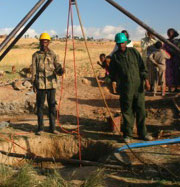
We sadly travelled away from the lodge and headed to visit Wukro Town and saw an example of integrated water management being managed by REST. This included erosion measures designed to reduce the amount of sand washed down a gorge, thus spoiling the land for farming. It also included a visit to the site of a hand dug well which was still under construction. The well was 15 metres deep from the bottom of the well to the top where I was standing.
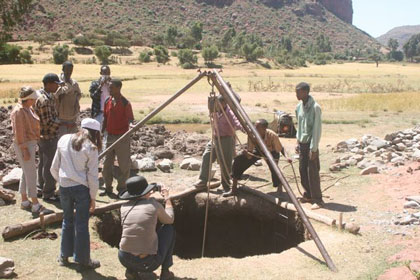
Looking down the deep hole.
Later we went to a local dairy farm. The yard was bigger than the actual house! Outside was the orchard which had lots and lots of fruit trees. At the edge of it, there was a black and white cow and opposite her tied to a tree was her calf. There was a mulberry tree with fresh, ripe mulberries on it. Yummy!
Afterwards we stopped and had a look at an informal school. An informal school is one that is not supported by the government. It provides the gap between staying at home and formal school if you can afford it. REST manages these schools. The school was inside some sort of shed. I would say there were around 90 children squashed inside. We gave them the rest of our school supplies and were on our way to Mekelle.
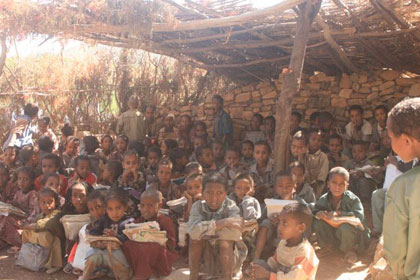
The 'Informal' school.
We arrived at the Axum Hotel in Mekelle. The weird thing is that we were actually in Mekelle, but it is called the Axum. This is because Axum was made famous as it was the ancient capital of Tigray when Queen Sheba ruled. Lunch consisted of chicken sandwiches and sprite. Then Mum, Jasmine and I went down town. Jassy and I got our hair braided like the African women do. It is only braided on one side, but still cool. It looks great.
Next, we showered and dressed and went to a function/night club for dinner. Jas and I had pasta while the adults had traditional injera. The place was full of dancing, singing, music and laughter. It was so much fun!!!!! Jasmine and myself were given African dresses. They were so beautiful. Mum, Ross, Robyn and Marianne were each given a roll of sheepskin with a stunning painting on it – each different from the last, but they all related to each other. It was a really great evening!
Love Marena
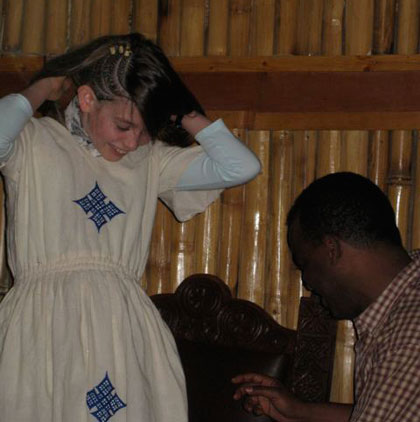 My new dress. My new dress.
Friday 17 October 2008
Dear Diary,
Another early start at 5 am. Today we are going home! Hay! No! I feel happy, but sad at the same time. I haven’t seen Dad or Christian for ages so I am happy to go back to them. But I have fallen in love with Ethiopia’s beautiful scenery and people. I way prefer Ethiopia’s beautiful mountains, churches and valleys to Abu Dhabi’s flat dry horizon so I am sad to go.
We flew on Ethiopian Airlines to Addis Ababa from Mekelle, Lovely scenery. Afterwards we went to the same hotel that we stayed in the first time we were in Addis Ababa. We then went to a hairdresser where Jas and I got our hair elastics in the school colours, ready for our return to a very different school from what we had witnessed here!
Then we went to the National Museum of Ethiopia. The highlight of this museum, amongst many amazing archeological finds from this ancient area, is “Lucy” – the oldest adult human skeleton. She is almost 3.2 million years old and walked fully upright when alive. They displayed her skeleton in a glass cabinet [40% complete and 60% re-constructed from plastic], and showed us how they knew that she was a girl [she had wide hips]. We talked about how Lucy is believed to be the link between man and ape. Another found skeleton was “Selam”, who’s even older at 3.3 million years. She is not as famous as Lucy, since she did not live to be an adult. We know this from both their teeth. She had wisdom teeth. Selam did not. It was a very interesting experience!
Time to go on the plane back home to Dubai.
Love Marena
Marena can be contacted on seejasmarena@yahoo.com
BACK TO TOP
|